
The world has changed drastically throughout the past few years, and the energy industry is no different. Outside of geothermal, federal support for renewable energy has nearly vanished, even as energy demand continues to increase. With the rapid acceleration of Artificial Intelligence (AI) driving the expansion of industrial-scale data centers, projected energy demand is higher than ever before, requiring a modern mix of solutions to meet anticipated load growth.
While the daytime production and weather intermittency aspects of solar energy generation have historically been a financial drawback of solar power, the increasing affordability of adding utility-scale Battery Energy Storage Systems (BESS) to the grid is creating market conditions that favor installing more solar power. Given the forecastable nature of both daily and seasonal solar power contributions to the electric grid, its minimal maintenance requirements, and its overall affordability, industry experts across the board agree that solar energy is a key tool in the modern mix.
Solar Farm Economics
Lazard’s 2025 Levelized Cost of Energy+ Report (LCOE+) found that renewable energy remains competitive overall, with utility-scale solar among the “lowest-cost and quickest-to-deploy generation” in the United States. In the LCOE+ graph below, we see utility-scale solar photovoltaic (PV) generation costs two to three times less than both gas peaking plants and nuclear plants.
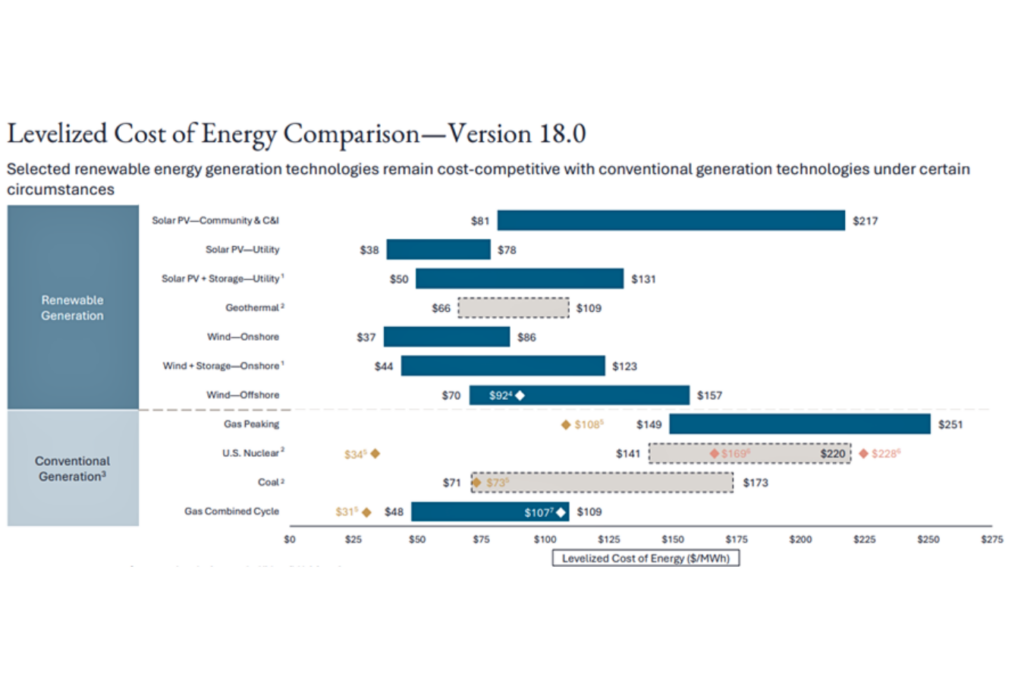
Visual comparison of the cost of energy from Lazard’s 2025 Levelized Cost of Energy+ Report.
OBBB’s Effect on Solar
The federal One Big Beautiful Bill (OBBB), signed into law in July 2025, has had noticeable effects on the US solar industry. Although many renewable energy initiatives were cancelled, the OBBB establishes rules and tariffs to reduce the use of Chinese components in the United States’ solar projects by protecting domestic manufacturing (Shulz Trade Law).
What may initially drive solar prices up due to the lack of supply amid increasing demand can be addressed through continuous capacity growth at the domestic manufacturing level. This may improve future supply chain efficiency.
Solar’s Role in Data Center Development
Expert projections point to significant near-term increases in peak electricity demand from AI-driven data centers and industrial facilities. For example, in Michigan, there are already 71 operating data centers (Data Center Map), and approximately 16 new data centers in various stages of development (MLive). This growth is at least partially attributable to the data center tax break signed into law as Public Act 207 by Governor Gretchen Whitmer in 2024 (Downtown Publications). As discussed above, solar energy remains one of the most cost-effective ways to meet this increasing electricity demand in today’s economy.
Many large technology companies have already implemented effective renewable energy and sustainability initiatives to offset energy consumption by their energy-hungry facilities and avoid undermining their corporate Environmental, Social, and Governance (ESG) goals. In fact:
An estimated 38% of tech companies now incorporate solar arrays directly at their facilities, while 36% utilize battery storage to mitigate fluctuations in supply. (Rated Power)
Similarly, data center developers seeking long-term energy cost savings, greater grid stability, and increased public support should incorporate solar energy generation and BESS in their proposed developments.
Solar’s Role in Municipalities
With the affordability of solar installations, municipalities are leveraging clean, renewable energy generation to achieve their sustainability and environmental goals. Take the City of Detroit, for example.
Within the City of Detroit’s Climate Strategy, the City outlines one of its four strategies to support reducing greenhouse gas emissions and adapting to the effects of climate change, including transitioning to clean energy. In support of this, the plan outlines three strategic initiatives:
- Power 100% of municipal electricity usage with clean energy by 2034.
- Launch a solar program to generate clean energy on City-owned sites and provide community benefits to residents.
- Work with utility providers and private property owners to source 50% of Detroit’s electricity from clean energy.
The City’s Solar Neighborhood program – a multi-year project transforming 165 acres of vacant land into solar arrays that will generate 31MW of energy – supports these initiatives. With the $21 million upfront costs covered by the City’s Utility Conversion Fund, no new appropriation from taxpayers is required for this project.
The Solar Neighborhood initiative offers the City a solution to reduce energy costs for residents, small businesses, and municipal buildings, while increasing electricity reliability and transforming blighted areas into efficient, productive spaces.
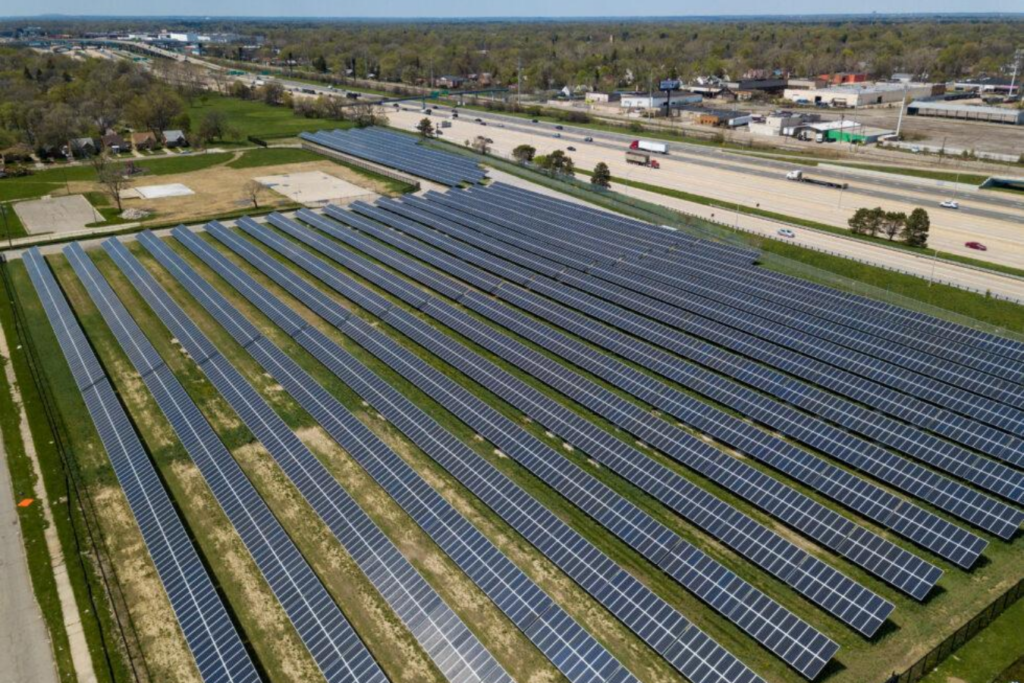
Image from DTE “City of Detroit – Greenfield Park Solar Neighborhood Project.”
Additionally, we’re seeing municipal support for solar initiatives at the state level across the country, including a surge in community solar bills.
For example, Wisconsin’s legislature is likely to pass a community solar bill, which would trigger approximately 50 projects statewide. The bill would enable community solar projects to contribute alongside utility companies and cooperatives, allowing communities and developers to build small-scale “solar gardens” that nearby residents can pay to subscribe to, thereby increasing grid stability and lowering energy costs. (Wisconsin Public Radio).
These small-scale solutions don’t overhaul the country’s utility grid but rather support local needs and enhance grid resiliency, with long-term improvements that improve local air quality and address the climate crisis.
Is solar here to stay?
As one of the lowest-cost and quickest-to-deploy energy generation tools, solar proves itself to be a valuable asset in today’s energy mix, helping address load growth. Despite changing federal energy priorities, the need at the state and local levels remains for a more robust, resilient energy supply to meet rapidly rising technology industry demands.
With our multidisciplinary experience in solar energy development, our Renewable Energy team at Metro Consulting Associates (MCA) guides communities, public utilities, and private developers through site selection, permitting, funding, engineering, and more.
Contact us today to discuss your next solar energy development.